

How High-Lumen Projectors Became Smaller and Lighter
How High-Lumen Projectors Became Smaller and Lighter
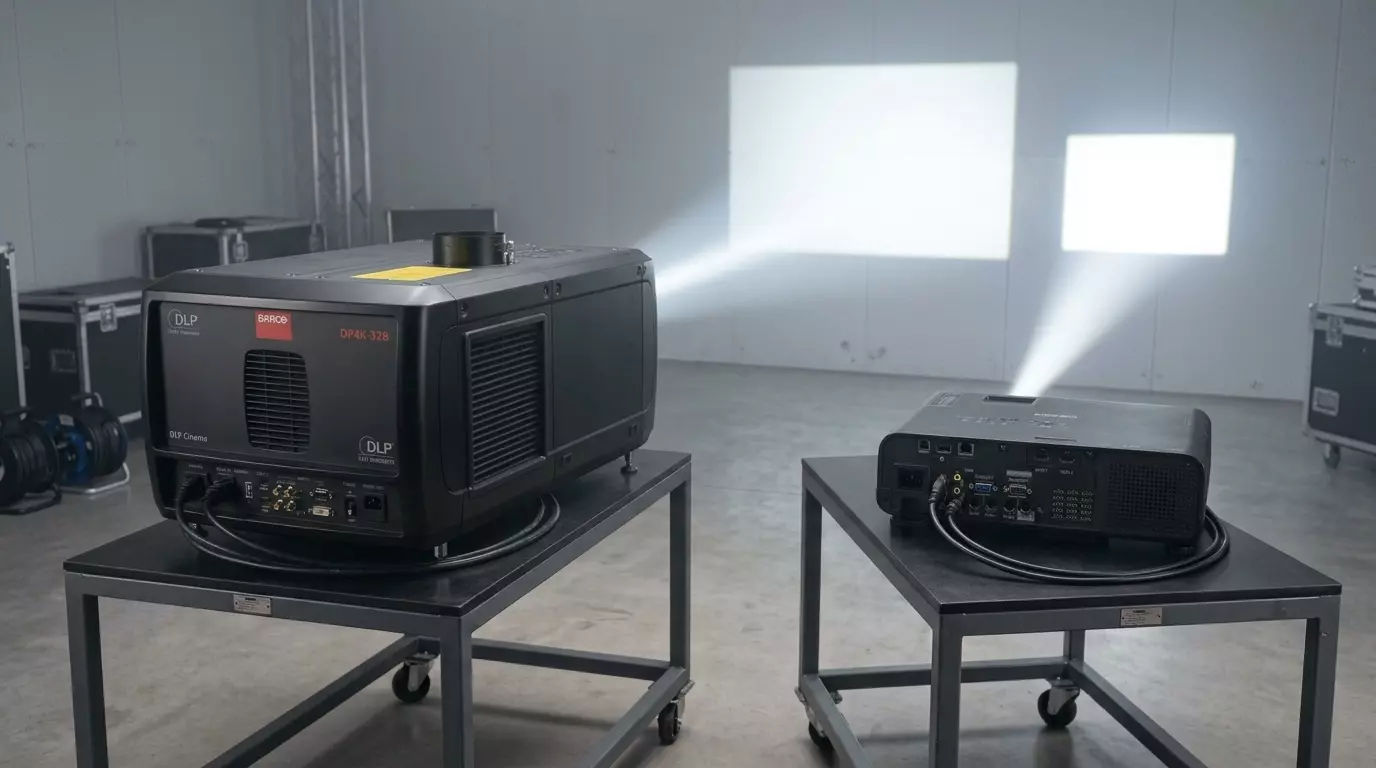
Professional projectors have changed dramatically over the last decade. Resolution, laser light sources and image processing usually receive most of the attention, but one of the most practical changes has been much simpler: high-lumen projectors have become substantially smaller and lighter.
This is particularly noticeable in the large-venue projector market. Outputs that once required projectors weighing 50 kg, 70 kg or more can now be achieved with significantly smaller equipment. At the same time, manufacturers are continuing to push more light output from approximately the same physical cabinet size.
For projection mapping, immersive installations, rental companies and permanent AV systems, this change has practical consequences. Smaller projectors are easier to transport, easier to rig, require less structural capacity and can fit into locations where previous generations simply would not.
Brightness Is Increasing Faster Than Projector Size
A useful way to understand this change is to look at brightness density: how many lumens a projector produces relative to its weight or physical size.
Lumens per kilogram are not an image-quality measurement, but they are useful when evaluating the physical evolution of professional projection equipment. Another useful comparison is lumens relative to the approximate external volume of the projector cabinet.
The figures below use manufacturer-rated light output and published projector dimensions. Approximate cabinet volume is calculated using width × height × depth, so it represents a simple bounding-box comparison rather than the exact internal volume of each projector.
| Projector | Year / Technology |
Brightness | Weight | Dimensions (mm) | Lumens / kg |
|---|---|---|---|---|---|
|
Epson 20,000-Lumen Comparison — same brightness, much smaller and lighter |
|||||
|
Epson Pro L20002UNL |
2019 Laser 3LCD |
20,000 lm | 50.3 kg | 620 × 280 × 720 | 398 |
|
Epson EB-PU2220B |
2022 Laser 3LCD |
20,000 lm | 24.4 kg | 586 × 185 × 492 | 820 |
|
Panasonic 20,000-Lumen Comparison — same brightness, smaller and lighter |
|||||
|
Panasonic PT-RQ22K |
2018 Laser 3-Chip DLP |
20,000 lm | 54 kg | 598 × 270 × 725 | 370 |
|
Panasonic PT-RQ25K |
2022 Laser 3-Chip DLP |
20,000 lm | 35 kg | 550 × 220 × 570 | 571 |
|
Panasonic High-Output Comparison — nearly the same size, substantially more light |
|||||
|
Panasonic PT-RQ35K |
2020 Laser 3-Chip DLP |
30,500 lm | 69.8 kg | 598 × 353 × 780 | 437 |
|
Panasonic PT-RQ45K |
2026 Laser 3-Chip DLP |
42,000 lm | 66.7 kg | 598 × 352 × 780 | 630 |
Dimensions are manufacturer-published external dimensions shown as width × height × depth. Projector weights may exclude interchangeable lenses. Brightness measurement standards can vary between manufacturers, so the most meaningful comparisons are between related generations from the same manufacturer.
Brightness ratings should always be compared carefully. Manufacturers may publish ISO/IEC, ANSI, centre-lumen, white-light-output or colour-light-output values depending on the projector. The most reliable comparisons are therefore usually between related models from the same manufacturer using comparable measurement methods.
A 20,000-Lumen Epson Projector Lost About Half Its Weight
One of the clearest examples comes from Epson’s professional large-venue projector lineup.
The older Epson Pro L20002UNL
produced 20,000 lumens while weighing approximately 50.3 kg without a lens. Its body measured approximately 620 × 280 × 720 mm.
The newer Epson EB-PU2220B
also produces up to 20,000 lumens, but weighs only about 24.4 kg without a lens and measures approximately 586 × 185 × 492 mm.
Using those published dimensions, the difference is substantial:
- Brightness: essentially unchanged at 20,000 lumens
- Weight: reduced by approximately 51%
- Bounding-box volume: reduced by approximately 57%
- Lumens per kilogram: increased from roughly 398 to 820
In other words, Epson more than doubled the amount of rated light output produced per kilogram of projector.
When Epson announced the EB-PU2220B generation in 2022, the company specifically highlighted this change. Epson described the new 20,000-lumen models as approximately 50% lighter and more than 60% smaller than their predecessors, depending on the comparison methodology.
You can read Epson’s original product announcement here:
Epson Launches New Generation of Pro Series High Lumen Projectors.
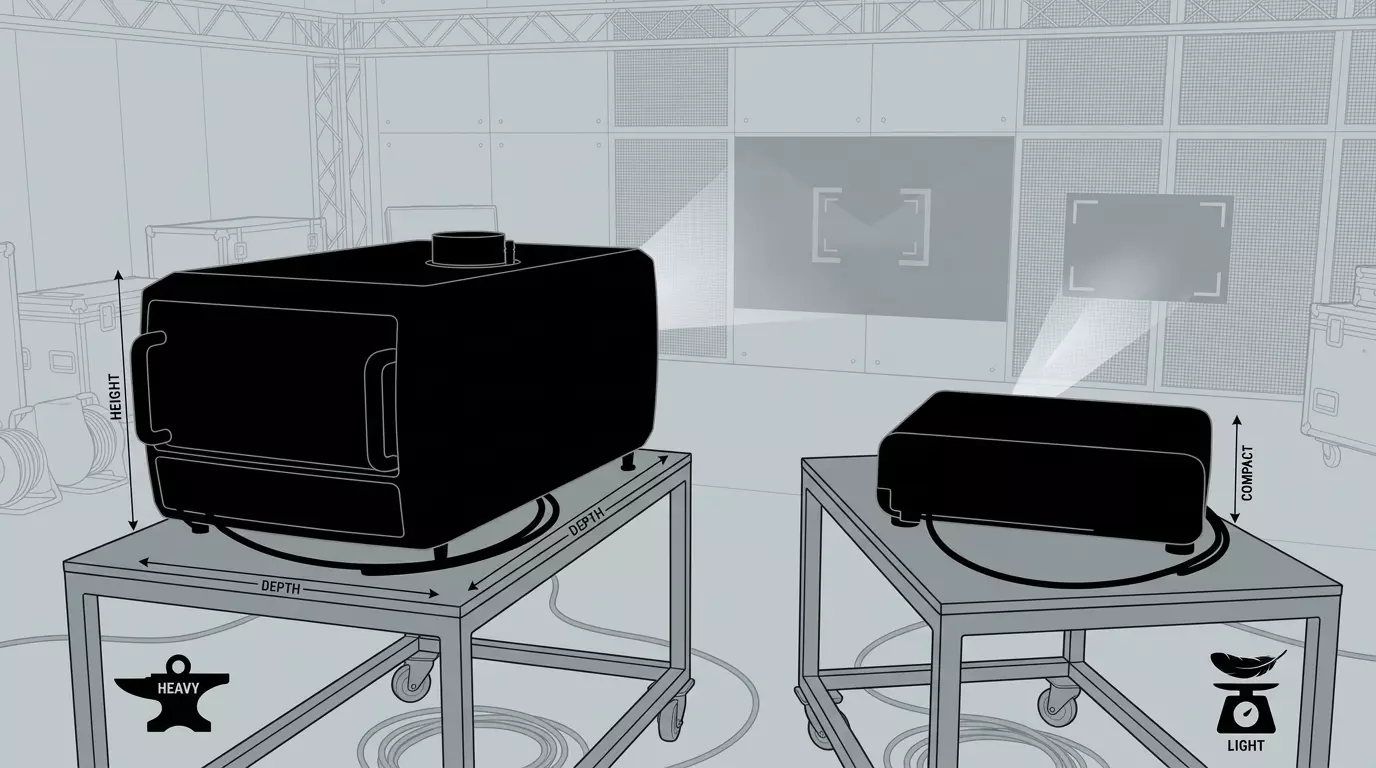
Panasonic Shows the Same Trend in 3-Chip DLP Projectors
The same trend can be seen with Panasonic’s large-venue 3-chip DLP projectors.
The Panasonic PT-RQ22K was considered compact when it was introduced. It produced approximately 20,000 lumens from a body measuring around 598 × 270 × 725 mm and weighed approximately 54 kg.
Its newer relative, the Panasonic PT-RQ25K, produces the same 20,000-lumen class output while measuring approximately 550 × 220 × 570 mm and weighing about 35 kg.
Panasonic states that the PT-RQ25K platform is approximately:
- 40% smaller than the PT-RQ22K by cabinet volume
- 35% lighter
Our calculation using the published external dimensions produces a similar result: approximately 41% less bounding-box volume.
Panasonic attributes the reduction to several engineering developments, including a miniaturized optical engine, smaller power supply, high-efficiency cooling system and revised optical-unit materials.
Panasonic has also discussed the logistical impact directly. According to the company’s sustainability documentation, reducing the PT-RQ25K’s size and weight allows it to be handled by fewer people compared with its predecessor.
More information:
Panasonic – Distribution, Sales and Installation.
Now Manufacturers Are Getting More Lumens From the Same Size Projector
The next stage of projector development is arguably even more interesting. Instead of simply making a projector smaller while maintaining the same brightness, manufacturers are beginning to dramatically increase brightness without increasing cabinet size.
Panasonic’s PT-RQ35K is rated at approximately 30,500 lumens and measures about 598 × 353 × 780 mm. It weighs approximately 69.8 kg.
The newer Panasonic PT-RQ45K is rated at 42,000 lumens while measuring approximately 598 × 352 × 780 mm and weighing around 66.7 kg.
The physical dimensions are therefore almost identical, yet rated light output has increased by approximately 38%.
At the same time:
- Weight is slightly lower
- Lumens per kilogram increase by approximately 44%
- Brightness per unit of external cabinet volume increases by approximately 38%
Panasonic specifically describes the PT-RQ45K as delivering higher output while maintaining almost identical body dimensions to the PT-RQ35K series.
This is an important shift. A physical space that previously accommodated a roughly 30,000-lumen projector can now potentially accommodate more than 40,000 lumens of projection output.
Why Are High-Lumen Projectors Getting Smaller?
It would be easy to attribute the entire change to laser projection, but the reality is more complicated.
Laser light sources have played an important role in modern projector development, particularly by eliminating replaceable high-pressure lamps and enabling different optical and thermal architectures. However, some early high-output laser projectors were still extremely large and heavy.
The continued reduction in projector size has come from improvements throughout the projector:
- Smaller optical engines
- More compact power electronics
- Higher-efficiency laser light sources
- Improved liquid and forced-air cooling systems
- Better thermal modelling
- More efficient optical paths
- Lighter cabinet and optical-unit materials
- More compact electronic processing hardware
The result is not simply a smaller box. Modern projectors are producing substantially more light for every kilogram of equipment that needs to be transported and supported.
Why Projector Weight Matters for Projection Mapping
A reduction from 50 kg to 25 kg may not sound important when comparing specifications on paper, but it can significantly change the way a projection system is designed.
Projector weight affects:
- Truss and mounting requirements
- Structural loading
- Number of technicians required for installation
- Lift and access equipment
- Shipping and freight costs
- Flight-case size and weight
- Warehouse storage
- Installation locations that can realistically be used
This becomes especially important on large projection mapping installations where multiple projectors are used. Saving 20 or 30 kg per projector can remove hundreds of kilograms from a large multi-projector system.
Smaller Projectors Also Change Outdoor Enclosure Design
Smaller projectors can also reduce the size of outdoor projector housings, but the relationship is not one-to-one.
A projector enclosure still needs space for:
- Cooling airflow
- Air filtration
- Intake and exhaust separation
- Lens clearance
- Cable connections
- Service access
- Mounting adjustment
- Weather protection
In fact, increasing brightness density creates an interesting engineering challenge. A smaller projector may produce more light while concentrating significant electrical and thermal load into a smaller space.
For example, Panasonic lists maximum power consumption of approximately 3,170 W for the 42,000-lumen PT-RQ45K, compared with approximately 2,550 W for the 30,500-lumen PT-RQ35K series. The newer projector produces substantially more light and is more lumen-efficient, but the cooling system surrounding it still needs to deal with a large thermal load.
This means outdoor projection systems should not select enclosure ventilation based simply on projector dimensions. Airflow, ambient conditions, projector power consumption and the manufacturer’s required operating temperature all need to be considered.
You can learn more about purpose-built outdoor projector protection here:
projection enclosures.
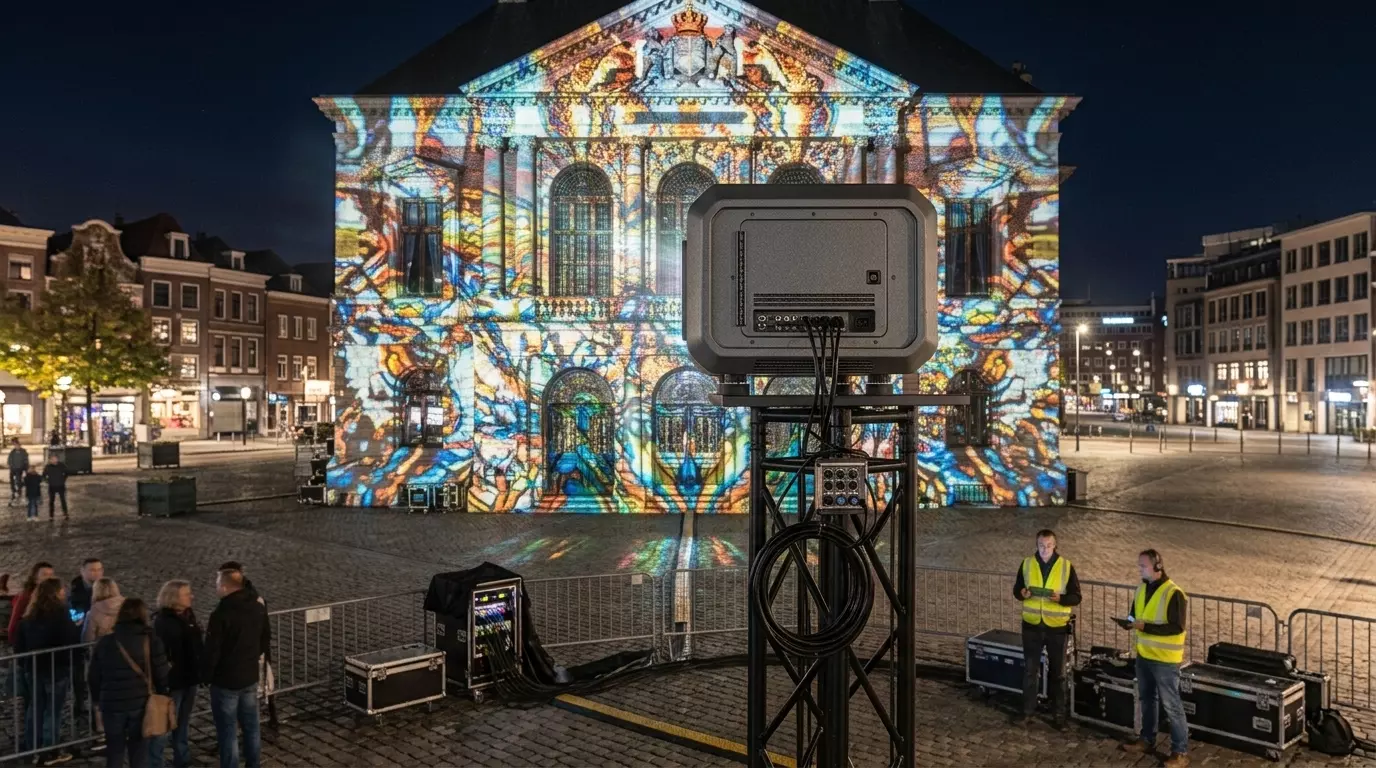
Smaller Projectors Open Up New Installation Locations
Projector size can sometimes determine whether a projection concept is feasible at all.
Large projectors need substantial clearance behind and around the unit for ventilation, lens access, cabling and maintenance. They may also require stronger structures and larger weatherproof enclosures.
Reducing the projector’s physical footprint can make it easier to install projection systems:
- Inside architectural features
- On rooftops
- Inside compact weatherproof enclosures
- On smaller truss structures
- Above pedestrian areas
- Inside museums and immersive attractions
- In temporary festival installations
For projection mapping designers, this creates more flexibility when selecting projector locations and can reduce the visual impact of the technical infrastructure surrounding an installation.
Projector Size Will Probably Continue to Matter More Than Ever
Professional projector development is no longer simply a race for maximum lumen output.
Manufacturers are also competing on how efficiently those lumens can be packaged, transported, cooled and installed.
The progression from a 50 kg 20,000-lumen projector to a roughly 24 kg equivalent is significant. So is the ability to move from approximately 30,000 lumens to more than 40,000 lumens without materially increasing projector dimensions.
For rental companies and projection mapping installers, that translates into real-world advantages: less freight, easier rigging, smaller supporting infrastructure and more options for projector placement.
For permanent and outdoor installations, however, the increased brightness density makes thermal management just as important as ever. Projectors may be getting smaller, but the engineering around them still needs to account for power, heat, weather, airflow and long-term reliability.
Planning a High-Brightness Projection Installation?
If you’re planning a projection mapping installation and need help selecting projectors, determining mounting locations or protecting equipment outdoors, you can send site photos and project information through our contact page.
As projector technology continues to improve, increasingly powerful projection systems can be installed in locations that would have been difficult or impractical only a few generations ago.