

Winter Festival Projection Mapping: A Practical Production Plan
Winter Festival Projection Mapping: A Practical Production Plan
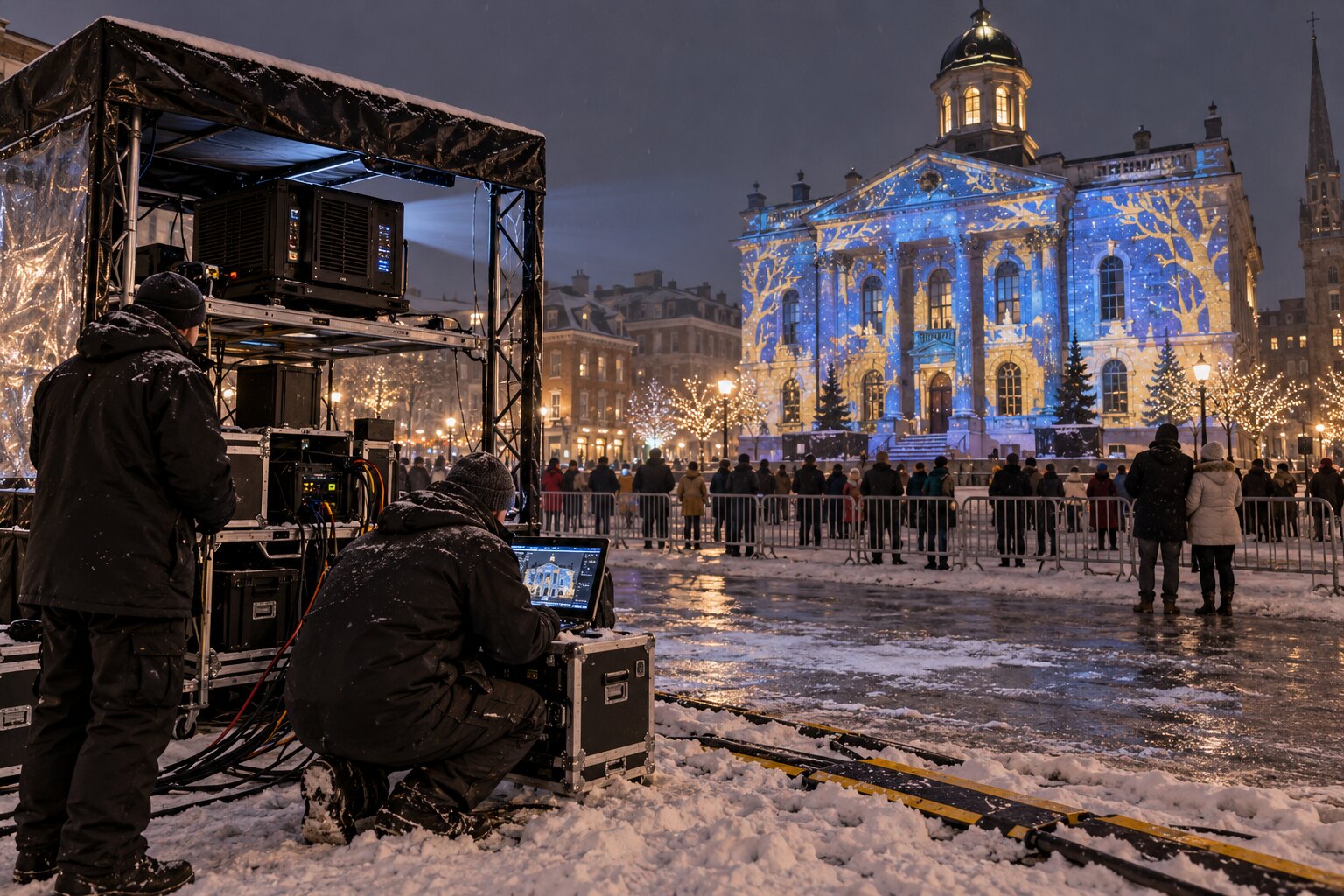
Winter attractions often look simple from the audience side: a building, a bright image and a crowd after dark. Behind the scene, a temporary projection team has to solve power, throw distance, snow, public access and show control on a deadline. A useful production plan makes those decisions before the equipment truck arrives.
This guide is for municipal event staff, ski hills, tourism organizations and technical directors planning a Christmas market, winter festival or short seasonal run. It focuses on the questions that affect the site and schedule, rather than assuming every event needs the same projector package.
Start with the experience and the operating nights
Define the exact audience route, viewing area, show length and nightly hours. Is the projection a timed show that gathers a crowd, or a visual layer people encounter while walking through the site? That choice affects audio, crowd management, staffing and whether the system can run unattended between scheduled checks.
Write down the first public night, the last operating night, rehearsal date and the earliest day crews can access the site. A three-week festival with daily operation needs a different weather and service plan from a one-night activation, even if the image is identical.
Choose the surface after a night visit
Bring the creative and technical leads to the site after dark. Photograph the facade from the audience position and possible projector positions. Record width, height, surface colour, texture, windows, signs and trees. Check competing light from street lamps, decorative lighting, vendor booths and vehicle headlights. A projector specified only from a daytime photograph can disappoint once the winter market opens.
Look for snowbanks, temporary fencing, food trucks and holiday decor that might block the beam later in the season. If projection crosses a public path, the plan must address access and public safety. Our brightness guide explains why image size and ambient light matter together.
Place the projector for the whole event, not only the test
Measure the throw distance and elevation from each viable position. Confirm the lens can cover the target surface with usable shift and minimal obstruction. Then check where the enclosure or temporary structure can actually stand, how it will be secured and whether it is accessible for service.
Coordinate rigging, ballast, structural review and weather exposure with qualified people responsible for those disciplines. A stand or truss rated for one component does not automatically cover the projector, enclosure, mounting hardware, wind exposure and cabling as a complete assembly.
Make winter weather part of the equipment scope
Outdoor projection must account for precipitation, wind, drifting snow and low-temperature starts, along with heat produced when the projector is running. The projector manufacturer’s permitted operating and storage conditions are the starting point. An enclosure must match the model’s intake and exhaust layout, lens position, service clearances and actual site exposure.
Keep snow-clearing routes, roof runoff and plowed piles away from intake and exhaust paths. Plan how the optical window will be checked and cleaned without disturbing alignment. Our outdoor enclosure guide covers the broader environmental questions, and the projection enclosures page is the place to discuss compatibility with a particular projector.
Give power and data their own drawing
Record the available electrical supply, distribution location, cable routes and the person responsible for connection. Confirm loads and protection with the qualified electrical team. Label every route that crosses an event work zone, service lane or public area. The media server and controls need a protected location and a clear plan for startup after an outage.
Decide whether content plays from a local system, a wired network or another connection. Do not make a public cellular connection the only way to run a scheduled show unless that dependency has been deliberately accepted and tested. Keep the approved show files and configuration backed up.
Build a load-in and rehearsal schedule with slack
- Before load-in: approve the site plan, permits, access, electrical scope, equipment list and content format.
- Load-in: install structures, power, weather protection, control equipment and projectors in a safe sequence.
- After dark: focus, warp and blend on the real facade; test at the expected ambient-light level.
- Rehearsal: run the complete show, including audio, scheduling and restart procedure.
- Operation: assign a daily visual check and an escalation contact.
- Strike: allow time for weather, access restrictions and safe removal.
Leave a correction window between the first full nighttime test and opening. Mapping and content adjustments that look small on a monitor can become obvious across a building.
Decide how the show fails gracefully
For an important event, ask what happens if a projector shuts down, a media server stops or the site loses power. A spare may be appropriate, but recovery can also mean a documented restart, reduced coverage, a substitute program or a clear cancellation threshold. The right redundancy depends on audience expectations and the cost of downtime.
Give the event manager one phone number for technical escalation and define who has authority to pause the display. Keep an incident log during a multi-night run so repeated faults are visible before the busiest weekend.
What to send for a useful event quote
Share the site address, facade photographs and approximate dimensions, event dates, nightly hours, audience location, proposed projector positions, available power and any projector models you already own. Include whether content and audio are needed, the desired creative style and the deadline for a first nighttime test. Label unknowns rather than guessing.
For a temporary festival display, explore Seasonal and Event Projection Mapping, then contact 360 Illumination with your site and dates to discuss a production scope.